

- Article published at:
- Article tag: Boozy Liquors
- Article comments count: 0
Drawer menu


While the world obsesses over French wine and Scottish whisky, the Philippines has been quietly cultivating an alcohol culture thatβs as wild, diverse, and intoxicating as its 7,641 islands. And unlike imported brands that demand you swirl, sniff, and sipβFilipino liquor demands you gulp.
Letβs crack this bottle open.

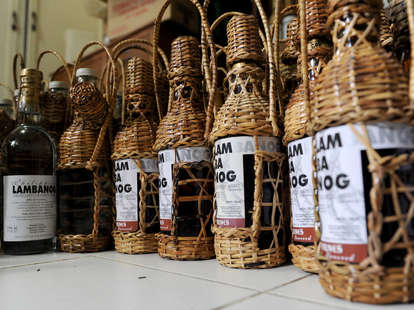
Image Source: thrillist.com | Jay Directo / Getty
You havenβt really drunk until youβve had Lambanog.
Also known as "coconut vodka," Lambanog is the moonshine of the tropics. It's made by distilling the sap of coconut flowers. It's cheap, itβs potent (often 40-45% ABV), and it tastes like a dare.
Itβs the countryβs OG hard alcohol drink.
In provinces like Quezon, it's practically a birthright.
It used to be homemade, dangerous, and wild. Now itβs getting polished with brands like Lakan Lambanog making it commercialβand safe.
Warning: It tastes like regret if you go too fast. But itβs Filipino pride in a bottle. To be honest, I don't like the raw taste of Lambanog (not for me), especially if it's not chilled. But there are lambanog drinks that are well crafted.
Example: Lakan's lambanog is the best lambanog liquor that I've tasted so far.Β

The world has Heineken. The Philippines has Red Horseβa strong beer that bites back.
At 6.9% ABV, it's got more muscle than your average brew.Β
Itβs one of the go-tos for affordable college parties, OFWs who missed it, and weekend warriors.
It's part of the holy grail of typical bonding in many Filipino homes as well.
Every now and then, you get the βHappy Horseββa mythical bottle believed to be stronger and deadlier. Superstitious? Maybe.Β
Never underestimate a beer with a horse on it. It doesnβt runβit kicks.